
LoRAverse: A Submodular Framework to Retrieve Diverse Adapters for Diffusion Models
 Middle East Technical University
 Virginia Tech
Abstract
Low-rank Adaptation (LoRA) models have revolutionized the personalization of pre-trained diffusion models by enabling fine-tuning through low-rank, factorized weight matrices specifically optimized for attention layers. These models facilitate the generation of highly customized content across a variety of objects, individuals, and artistic styles without the need for extensive retraining. Despite the availability of over 100K LoRA adapters on platforms like Civit.ai, users often face challenges in navigating, selecting, and effectively utilizing the most suitable adapters due to their sheer volume, diversity, and lack of structured organization. This paper addresses the problem of selecting the most relevant and diverse LoRA models from this vast database by framing the task as a combinatorial optimization problem and proposing a novel submodular framework. Our quantitative and qualitative experiments demonstrate that our method generates diverse outputs across a wide range of domains.
Method
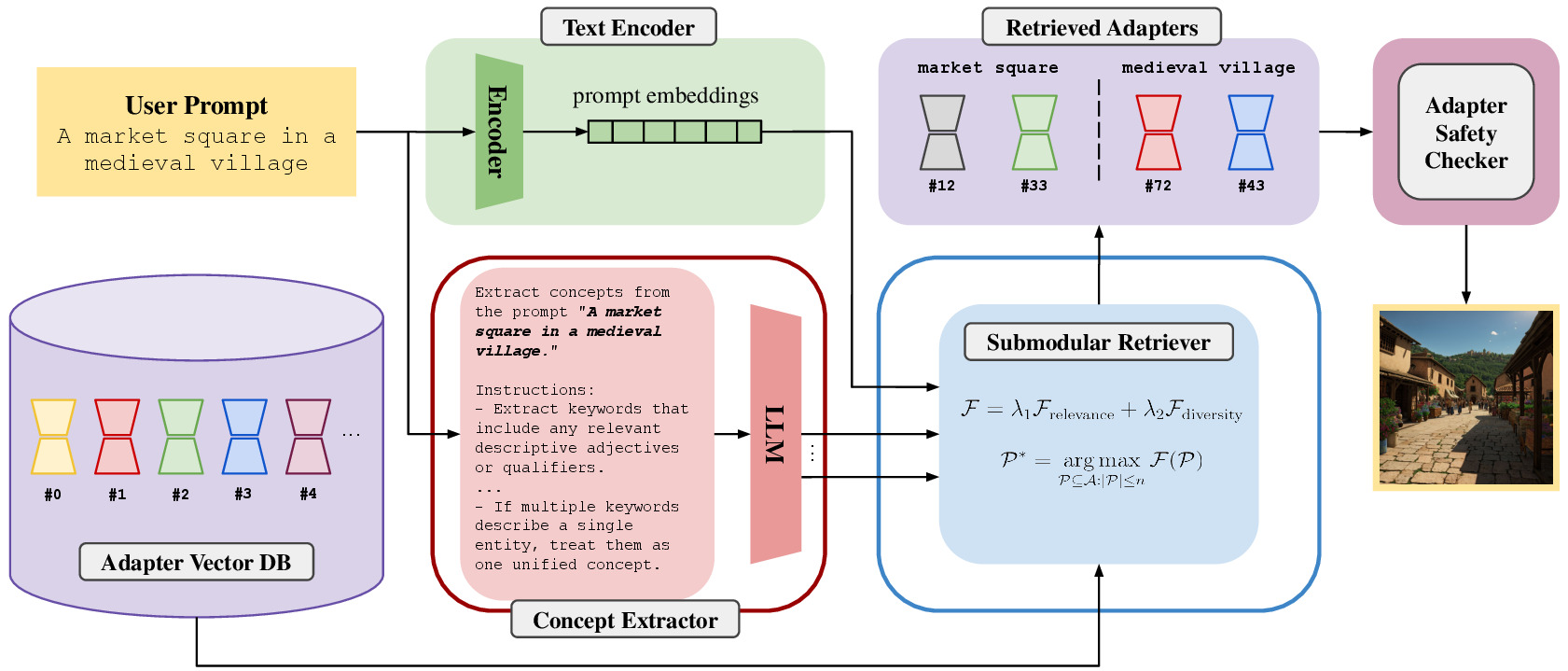
Architecture of LoRAverse. LoRAverse composed of two main modules: concept extractor and submodular retriever. The concept extractor processes the user prompt to identify concepts (keywords). These concepts guide to the submodular retriever, which selects a diverse and relevant subset of LoRA adapters by clustering similar adapters per concept and applying submodular optimization. Additionally, a safety-checking mechanism is integrated to filter out adapters containing offensive or inappropriate content.
Quantitative Results
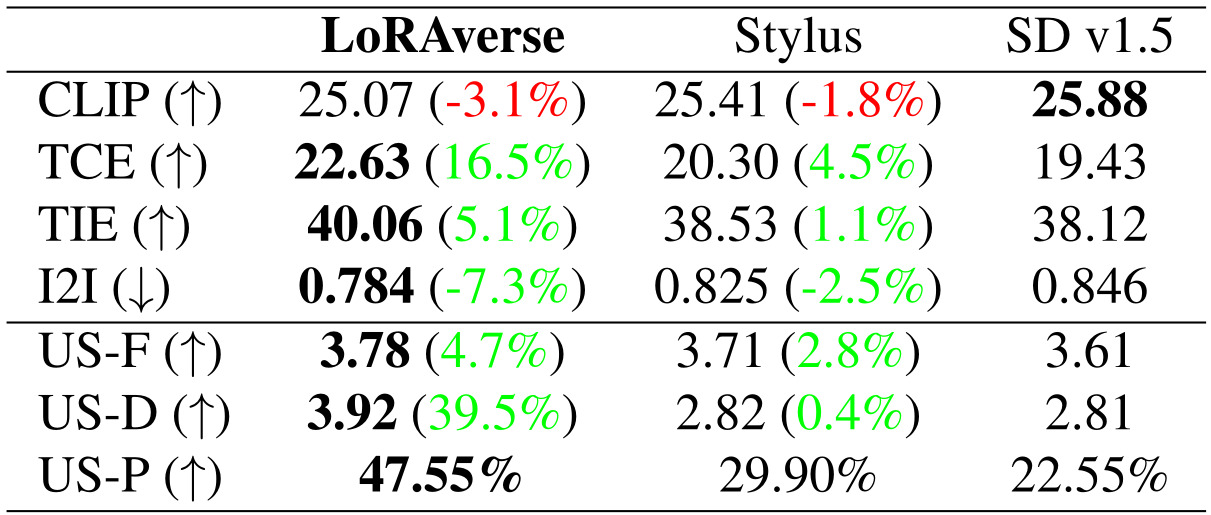
Quantitative Comparison (CFG=7). LoRAverse enhances the diversity of image sets across various metrics while maintaining comparable text-image alignment. The user study reports which method produced preferred outputs (US-P) by participants, and average rating of faithfulness (US-F) and diversity (US-D) of outputs on a scale of 1 to 5.
Qualitative Results
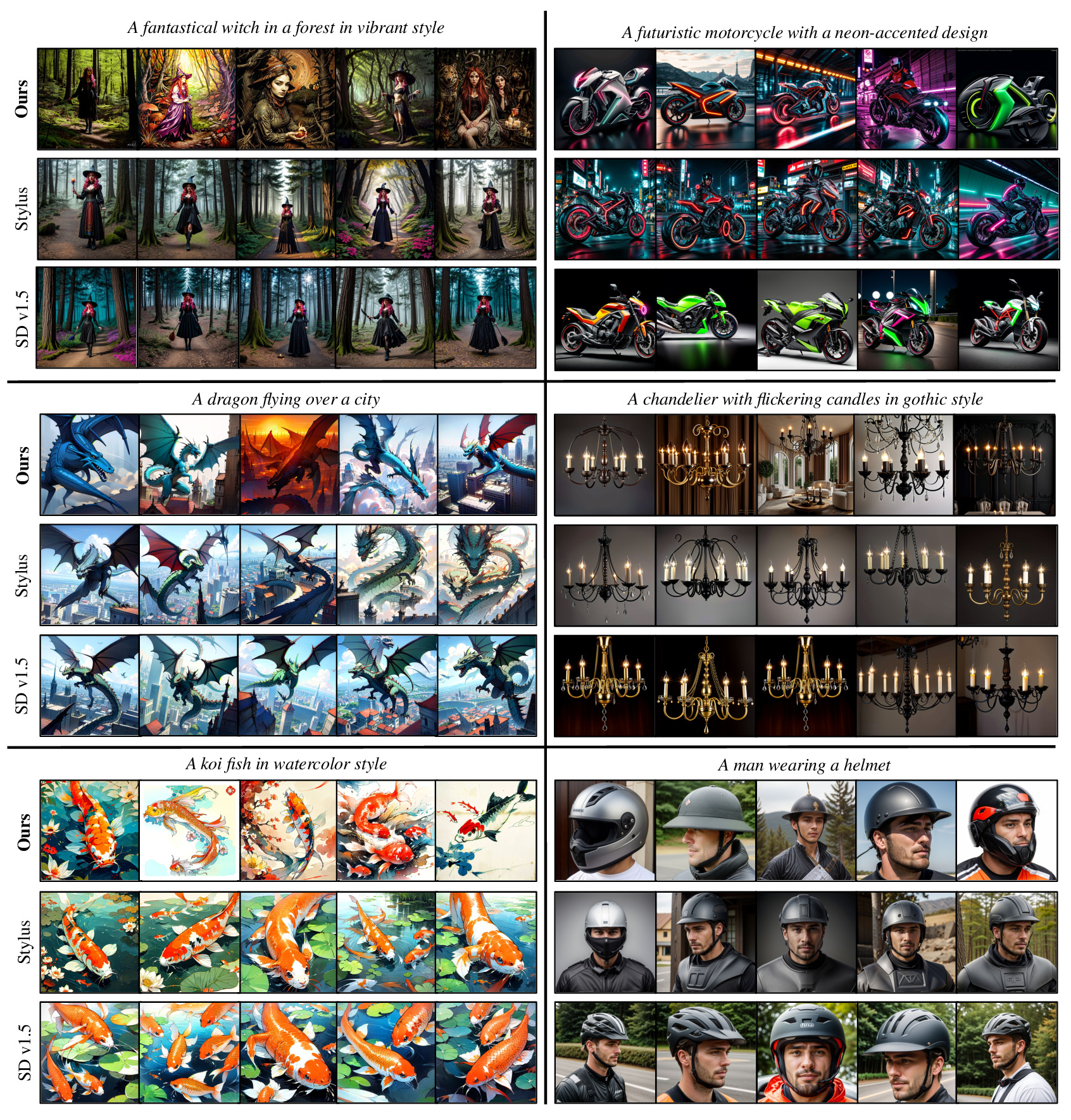
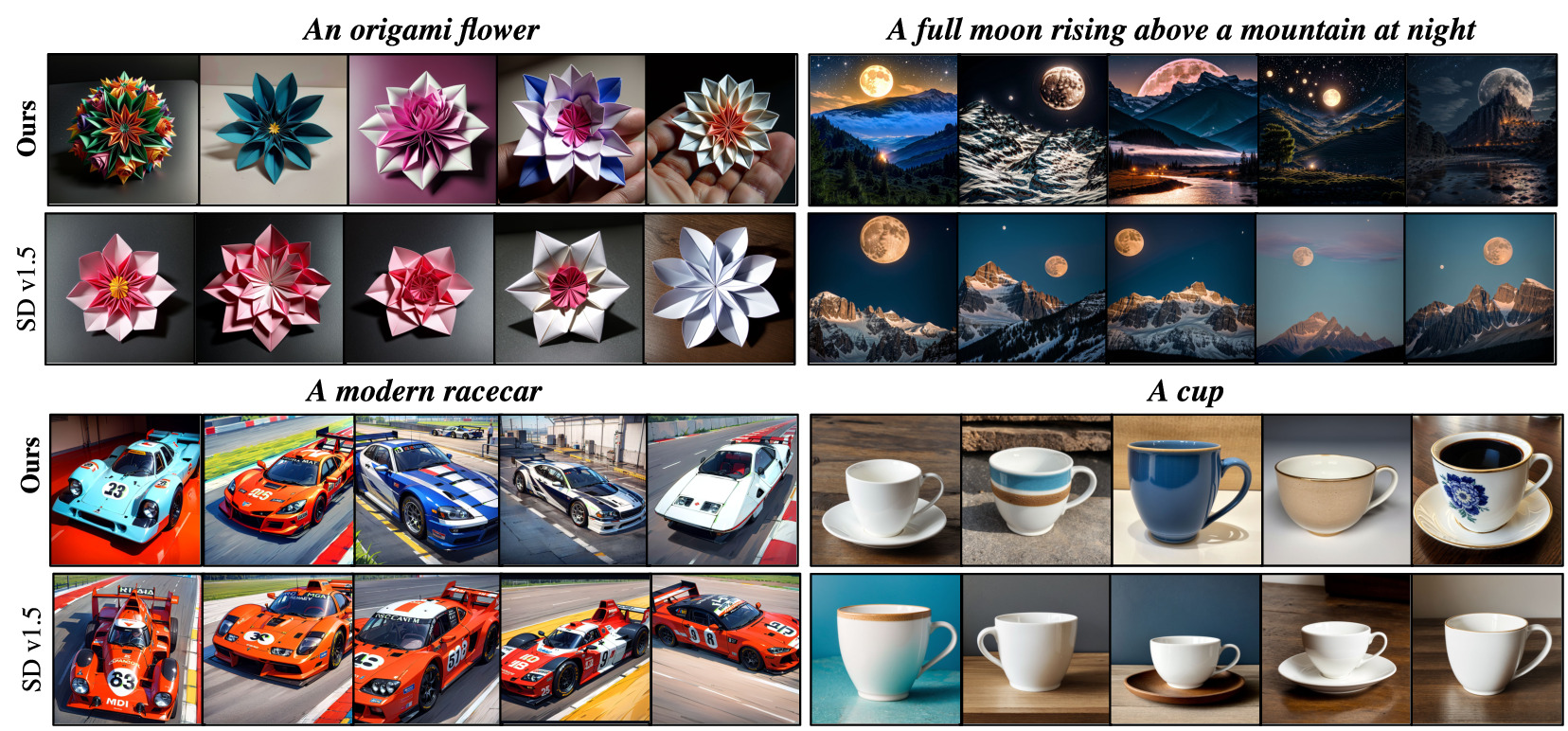
Qualitative Comparison. LoRAverse demonstrates a higher diversity compared to image sets generated by Stylus and SD v1.5.
BibTeX
@article{loraverse2025,
    title = {LoRAverse: A Submodular Framework to Retrieve Diverse Adapters for Diffusion Models},
    author = {Sonmezer, Mert and Zheng, Matthew and Yanardag, Pinar},
    booktitle = {Proceedings of the IEEE/CVF International Conference on Computer Vision (ICCV)},
    year = {2025}
}